
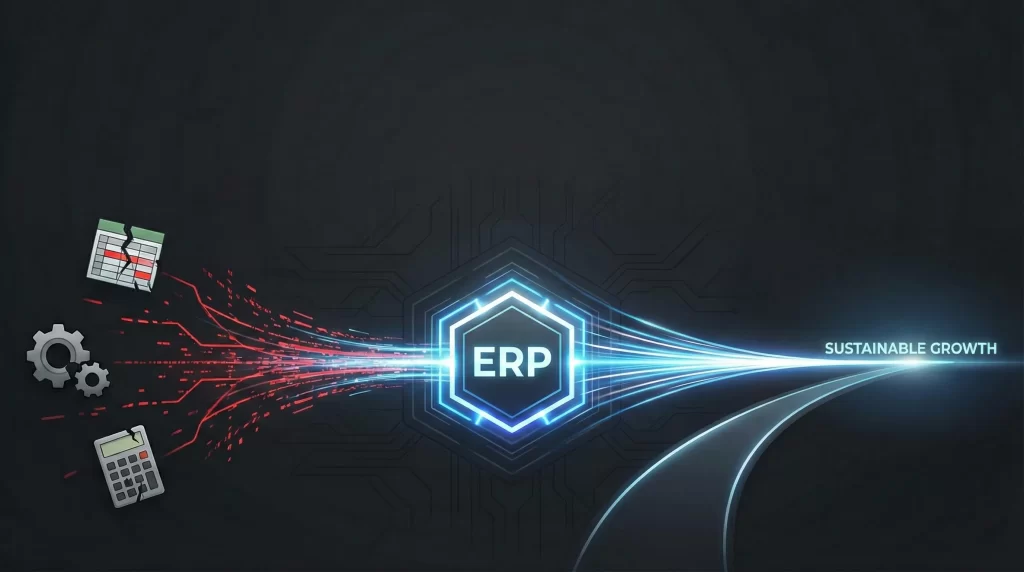
Many businesses eventually reach a point where their existing tools—Excel sheets, isolated accounting software, or separate CRMs—begin to limit their potential rather than support it. What once felt manageable becomes complicated as teams expand, data increases, and customers expect faster, more accurate service. When sales, finance, and operations each operate on separate systems that do not communicate, misalignment becomes inevitable. Numbers stop matching, decisions slow down, and errors start to multiply.
An Enterprise Resource Planning (ERP) system is often the solution that helps organizations move from reactive management to strategic and sustainable growth. It centralizes operations, connects departments, and creates the real-time visibility needed to run a modern business.
The Problem of Disconnected Systems
As a company grows, it naturally accumulates different tools for different tasks. Sales teams may rely on a CRM, accounting may continue with legacy desktop software, and warehouse operations may run on spreadsheets. Over time, these tools create silos—separate islands of information that cannot communicate with each other.
This creates several challenges. Reports take longer to prepare because someone must manually compile numbers from various systems. Customer service suffers because staff do not have immediate access to accurate inventory levels or delivery timelines. Leadership struggles to make informed decisions because they are working with outdated or inconsistent data. Eventually, the business finds itself spending more time fixing errors than creating value.
When Businesses Outgrow Spreadsheets
There are specific moments when organizations begin to realize that their current systems are no longer sufficient. One of the most common signs is when financial closing becomes increasingly time-consuming. If it takes weeks to reconcile monthly transactions, it is a clear indication that manual processes are overwhelming the team.
Another sign appears in customer interactions. When customers ask for stock availability or expected delivery dates and the team cannot give immediate answers, it reduces confidence in the brand. Similarly, decision-makers often feel constrained when it takes days to produce reports on profitability, inventory turnover, or department performance. These challenges indicate that the business has outgrown its tools and needs a more structured, integrated system.
How ERP Systems Resolve These Challenges
An ERP system replaces multiple disconnected tools with a single platform that unifies all business processes. Instead of maintaining several databases, the company operates from one accurate, real-time source of information. This eliminates discrepancies between departments and ensures that every team works with consistent data.
ERP systems also introduce a high level of automation. Processes that previously required manual entry—such as updating inventory, generating invoices, or preparing delivery notes—are executed automatically. This reduces the risk of human error and frees employees to focus on higher-value tasks.
The ability to access real-time analytics is another major advantage. Instead of relying on backward-looking reports, decision-makers gain visibility into ongoing performance, forecasts, and trends. This allows businesses to respond quickly to challenges and opportunities.
Security and compliance also become more manageable. Unlike spreadsheets or email-based processes, ERP systems offer structured permission levels, centralized data protection, and audit trails that safeguard sensitive information.
Why 360ground Recommends Investing in an ERP
At 360ground, we view ERP implementation not merely as a software upgrade but as a strategic transformation. A well-implemented ERP creates stability, transparency, and scalability—three pillars essential for sustainable growth.
Our approach begins with understanding your business deeply. Every company has unique workflows, approval processes, and reporting needs. For this reason, we do not believe in generic solutions. Instead, we ensure that the system adapts to your operational structure while bringing industry best practices into your processes.
We also prioritize long-term success. Implementation is only the first step. Training, continuous optimization, and ongoing support are essential to ensure your team fully benefits from the system.
Whether you are an emerging SME seeking more control and professionalism or an established business aiming to optimize complex supply chains, the right ERP system provides the structure and insight required to grow confidently.
Businesses that rely on spreadsheets and fragmented tools eventually face delays, inefficiencies, and data inconsistencies that hinder growth. An ERP system addresses these challenges by unifying operations, automating routine tasks, and providing real-time visibility into the entire business.
If your organization is ready to replace complexity with clarity, 360ground is prepared to support you. Together, we can build a strong digital foundation that drives long-term growth and operational excellence.